History of the Harp
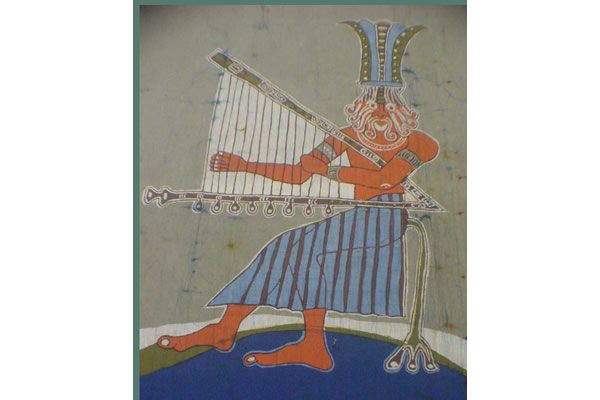
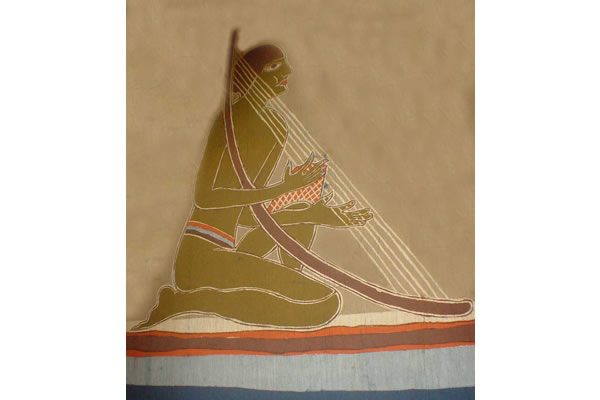
The harp occupies a position unique in the history of music. It is the oldest known instrument, having existed in one form or another, in every land and every age.

The frame harp, or a harp that included a straight forepillar (or column in the modern sense), first appeared in Medieval Western Europe in the 8th to 10th centuries AD. Although there are very few remaining in existence, art from that time indicates they utilized about ten or eleven strings. The first harp to feature a hollowed soundbox that amplified the instrument’s sound dates back to Ireland in the 14th century. It also included a curved forepillar, a stronger neck and 30 to 36 brass strings.
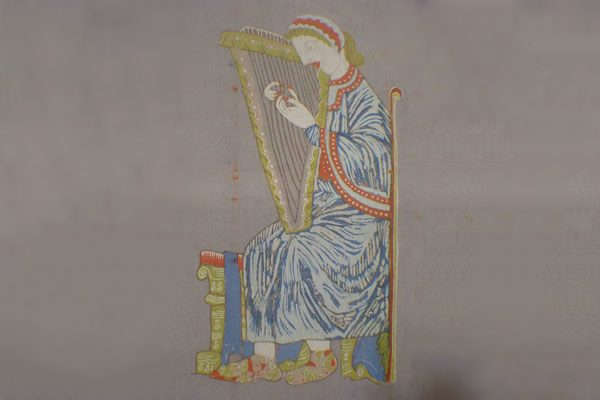
Harps in continental Europe differed from Irish harps in that the forepillar was thinner and less curved, the neck was more slender and it curved upward to meet the end of the column. Referred to as Renaissance harps, they typically had 24 or more gut strings which were fixed to the soundboard with brays (wooden pegs). By the end of the 17th century, they typically had staved sound bodies and straight forepillars.
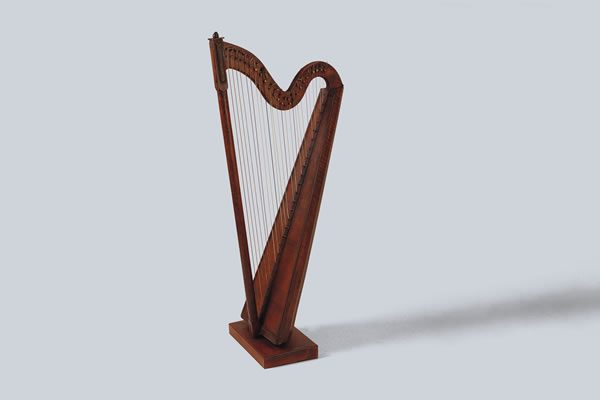
Triple-strung harps first appeared in Italy in the late 16th or early 17th century. They followed the invention of the double-strung harp, which had two rows of strings strategically tuned for use of two-handed playing; by passing a finger between two strings a harpist could reach the corresponding chromatic note in the other row. The triple-strung harp had three rows of strings, the two outer rows were tuned to the same diatonic scale while the inner row was tuned to the outer rows’ chromatic semitones. Two major benefits were that tunes with more rapidly repeated notes could more easily be played and that the doubled, or amplified, rows of the same notes increased the resonance of the instrument.
Approximately 1720, a less cumbersome way to get some chromatic notes from a single-strung harp tuned diatonically was introduced. Five pedals (eventually seven) were housed in the bottom of the soundbox. When depressed they connected to hooks that would sharpen the strings of the same note via linkages that passed through the column. The hooks were quickly improved to crochets, which were right-angled rather than u-shaped hooks, then to bequilles, sets of two small levers in which each string wrapped through; when a pedal was depressed, one lever would turn clockwise and the other counter-clockwise, providing a firmer grip. While a better system, they were prone to breakage and produced a buzzing noise.
Near the end of the 18th century, the single-action pedal harp was greatly improved. A model was introduced that had a soundbox built with a separate pine soundboard and a body that was reinforced with internal ribs. Brass action plates were attached to the outside of the harp neck, rather than inside providing strength to the linkage system. The most important improvement was the disc system. Two brass prongs (or forks) extended from a disc that a string passed through before attaching to the tuning peg. When the corresponding pedal was depressed, the discs turned and the strings sharpened a semitone, held firmly against the prong.
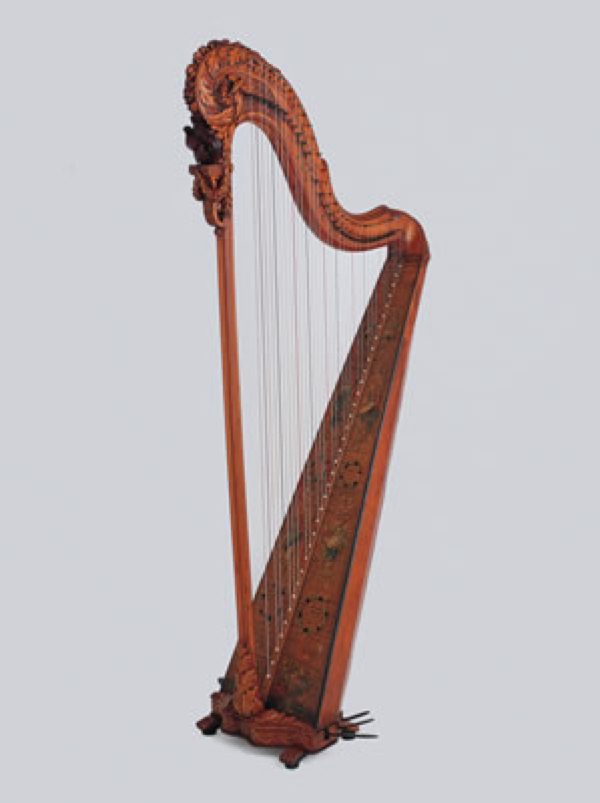
This unique version of the harp was introduced in the early 1800s. It had two necks, two bodies and two columns that crossed in the middle, each double-strung with 40 strings. A simplified version was made in the late 19th century with one body, column and a wider neck which two sets of strings descended, crossed and attached to the soundboard. This version was large and physically difficult to play and virtually abandoned by the mid 1950’s.
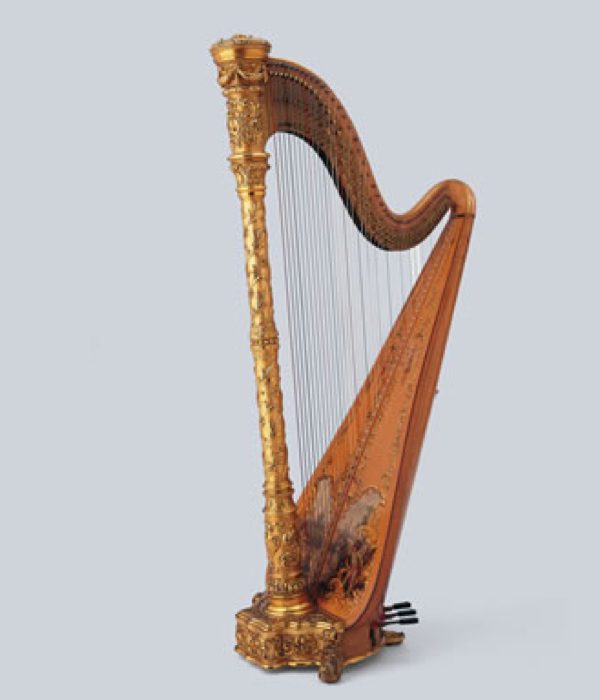
The only drawback to the single-action harp was that not every key could be achieved for playing. In 1810, a double-action pedal harp was patented in which the seven pedals could be depressed twice and each string passed through two pronged discs instead of just one. When a pedal was depressed into the first notch, the upper disc turned partially and firmly held the string so that it sharpened a semitone while the bottom disc turned partially but did not touch the string. To sharpen another semitone, the pedal was depressed again into a lower notch and the bottom disc turned further to grip the string even more. Aside from mechanical improvements, this system is still used today.
Jacques-Georges Cousineau (France, 1760-1824) invented the bequille and other mechanisms for the harp, was also a harp virtuoso.
Sebastien Erard (Germany, 1752-1831), developed the single action and double action harp, revolutionized the harp by the invention of the fourchette mechanism (discs with prongs) that is still used today.
Clelia Gatti-Aldrovandi (Italy, 1901-1989), esteemed harp soloist and respected teacher.
Marcel Grandjany (France, 1891-1976), successful harp virtuoso, esteemed teacher, helped found the American Harp Society.
Alphonse Jean Hasselmans (Belgium, 1845-1912), refined the techniques known as the French method of harp playing, instructed many respected harpists while harp professor at the Paris Conservatoire.
Lily Laskine (France, 1893-1988), harp prodigy with a long career including posts at the Paris Opera, Orchestre National de France, Theatre Francais and as professor of harp at the Paris Conservatoire; also a successful recording artist.
Harpo Marx (USA, 1888-1964), second oldest of the “Marx Brothers” – the popular vaudeville act and movie team of the 20’s and 30’s; taught himself to play the harp while never learning to read music; his two gold Lyon & Healy harps were donated to an Israeli university for student use upon his death.
Turlogh O’Carolan (Ireland, 1670-1738), blind harpist and composer of the harp, wrote many popular Irish airs.
Charles Oberthür (Germany, 1819-1895), renowned harpist and composer.
Elias Parish-Alvars (England, 1808-1849), considered one of the best harpists of all time; composer of concertos, fantasias and solos for harp, many still popular today.
Henriette Renié (France, 1875-1956), was one of the first successful female harp virtuosos and a respected teacher and composer.
Alberto Salvi (Italy, 1893-1983), renowned harpist, performed many solo concerts in a time when more harpists were accompanists; performed in many operas; recorded with RCA Victor and was popular on radio.
Carlos Salzedo (France, 1885-1961), widely credited as establishing the harp as a significant instrument in the 20th century; composed a large body of music pieces for the harp; esteemed harp virtuoso and beloved teacher; designed the Lyon & Healy Salzedo model harp.
Marcel-Lucien Tournier (France, 1879-1951), harp virtuoso and composer; succeeded Hasselmans as professor of harp at the Paris Conservatoire.
Nicanor Zabaleta (1907-1993), increased the popularity of the harp worldwide by aggressively touring and selling more than four million copies of his recordings.
Browse our harp catalog to find the harp which best fits your musicality.